 Florence City Guide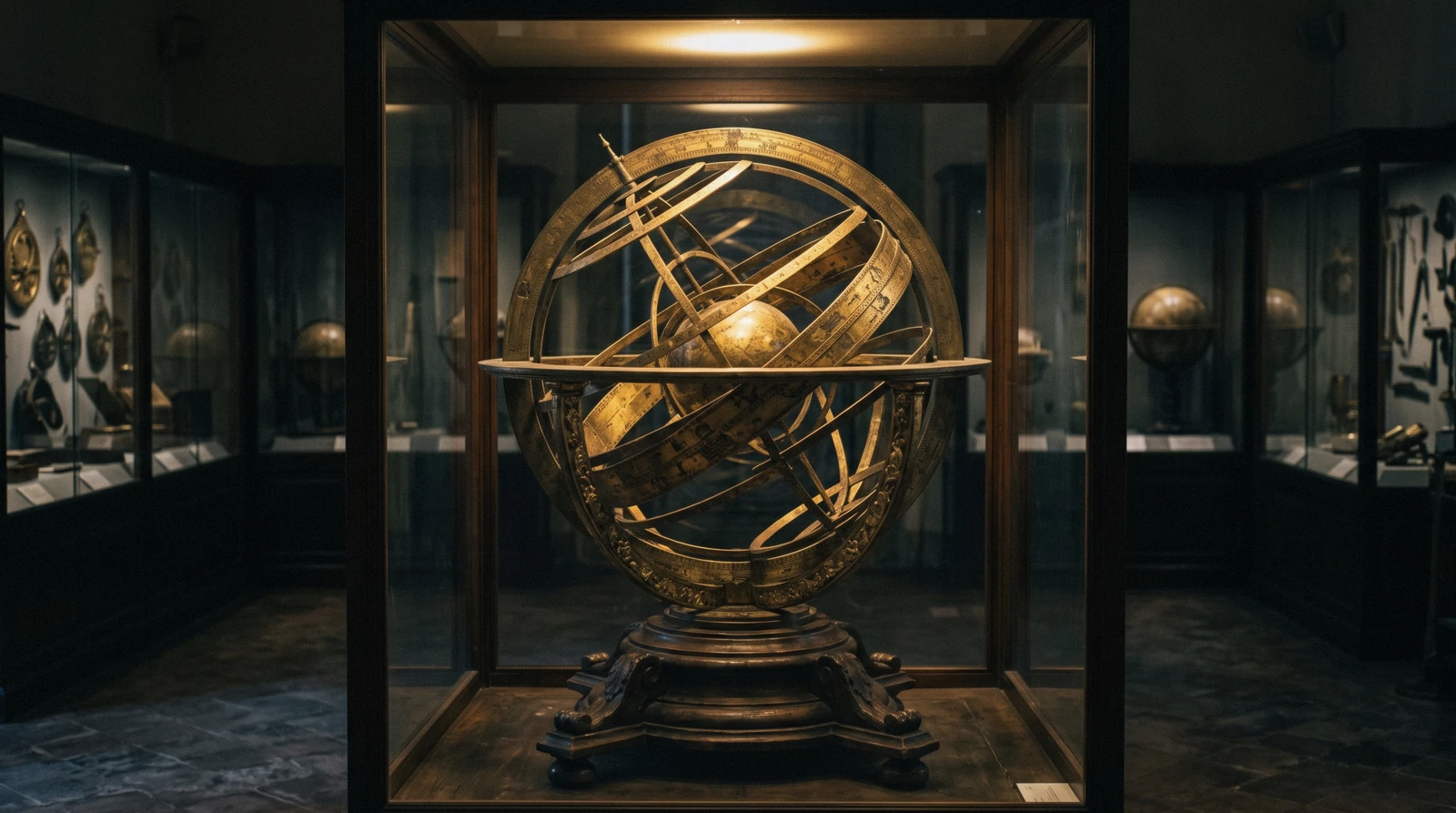
Museo Galileo
The Galileo museum Florence visitors mean is Museo Galileo, the science museum on the Arno embankment two minutes east of the Uffizi, in Palazzo Castellani — and it holds the only two telescopes Galileo built that still exist. It is also open on Mondays, when the Uffizi, the Accademia, the Bargello and the Pitti are all shut. This page has the ticket price and hours, what is in Room VII, how long to allow, and the Tuesday trap that catches people who read the wrong opening line; what to see in Florence covers the rest of the city.
Quick answer Price, hours, the finger, how long — in three lines
A Museo Galileo entry ticket costs €17 (about $20) and needs no timed slot. It opens Monday and Wednesday to Sunday 09:30–18:00 but only until 13:00 on Tuesday, and Room VII holds the only two telescopes Galileo built that survive, the objective lens through which he found Jupiter's moons, and the middle finger of his right hand.
Key takeaways
- Walk in with the entry ticket on your phone. There is no timed slot and no queue worth planning around, and the ticket is valid all day.
- It is one of the few good museums open on a Monday. Pair it with Palazzo Vecchio, the other Monday opener, three minutes away, and see every Florence museum's price and closed day for the rest of that day.
- Coming from Santa Croce? The museum grants a reduced rate to Santa Croce ticket holders. Galileo's tomb is in Santa Croce, nine minutes east, which makes the pair the natural half-day.
Key facts
Opening hours
| Monday, Wednesday–Sunday | 09:30–18:00 |
|---|---|
| Tuesday | 09:30–13:00 |
| Ticket sales | 09:30–30 minutes before closing |
Closed 1 January, 25 December. Tuesday is a half-day, not a closed day — except 2 June and 8 December 2026, which fall on Tuesdays and run to 18:00
Admission
- Adult
- €17 entry ticket (about $20)
- Reduced
- Reduced rate for ages 6 to 18 and for holders of a Santa Croce ticket or a Unicoop, Feltrinelli or ACI card. Family ticket for two adults and up to two under-18s, or one adult and three. Groups of 15+ must book
- Free
- Under 6; disabled visitors and a companion; licensed guides; EU journalists; ICOM and ANMS members
Planning it
- Time needed
- Not stated by the museum; our routing: about 1.5 hours, or 2.5 with the free app
- Book ahead
- Optional — walk-up usually fine
- Address
- Piazza dei Giudici 1, 50122 Firenze (step-free ramp at Lungarno Anna Maria Luisa de' Medici 2)
One way into Museo Galileo from the cards on this page, at the price GetYourGuide lists. The museum runs no timed-slot system, so the ticket is valid all day and there is no queue to plan around.
Are you here for the instruments, or filling a wet afternoon near Santa Croce?
| Option | Price | Includes | Cancel | Book |
|---|---|---|---|---|
| Museo Galileo entry ticketVisitors who want the entry sorted before the day, with free cancellation | €17 (about $20) | Entry, voucher on your phone | Free up to 24 hours before | Check Availability |
Valid all day, with no timed slot. Ages 6 to 18, families and Santa Croce ticket holders qualify for reduced rates, and the Firenze Card includes this museum with no reservation required. Listed prices move with the date and are confirmed at checkout. Figures current in Q3 2026.
This ticket, and the museums either side of it
The entry ticket first, then the three neighbours people pair it with. None of the other three includes entry to Museo Galileo.
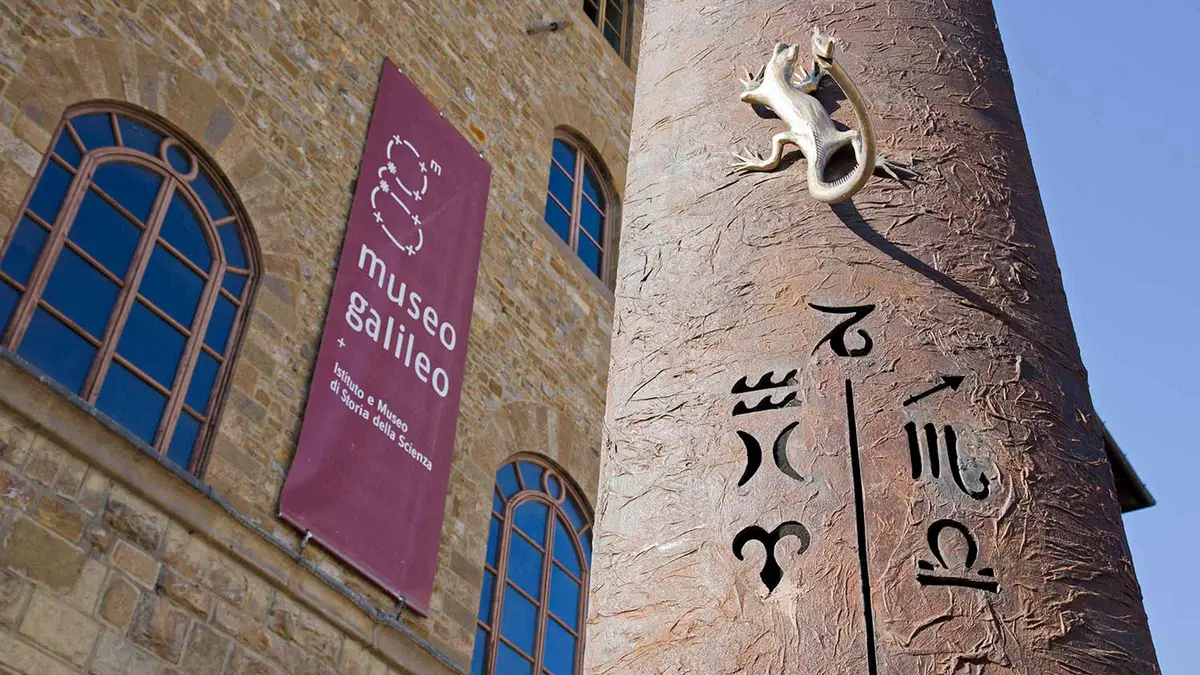 from €17
Florence: Museo Galileo Entry Ticket
listed at $19.85
Entry ticket sold by the museum itself: 18 rooms of Medici scientific instruments including Galileo originals. Tuesdays close at 1 PM.
Check Availability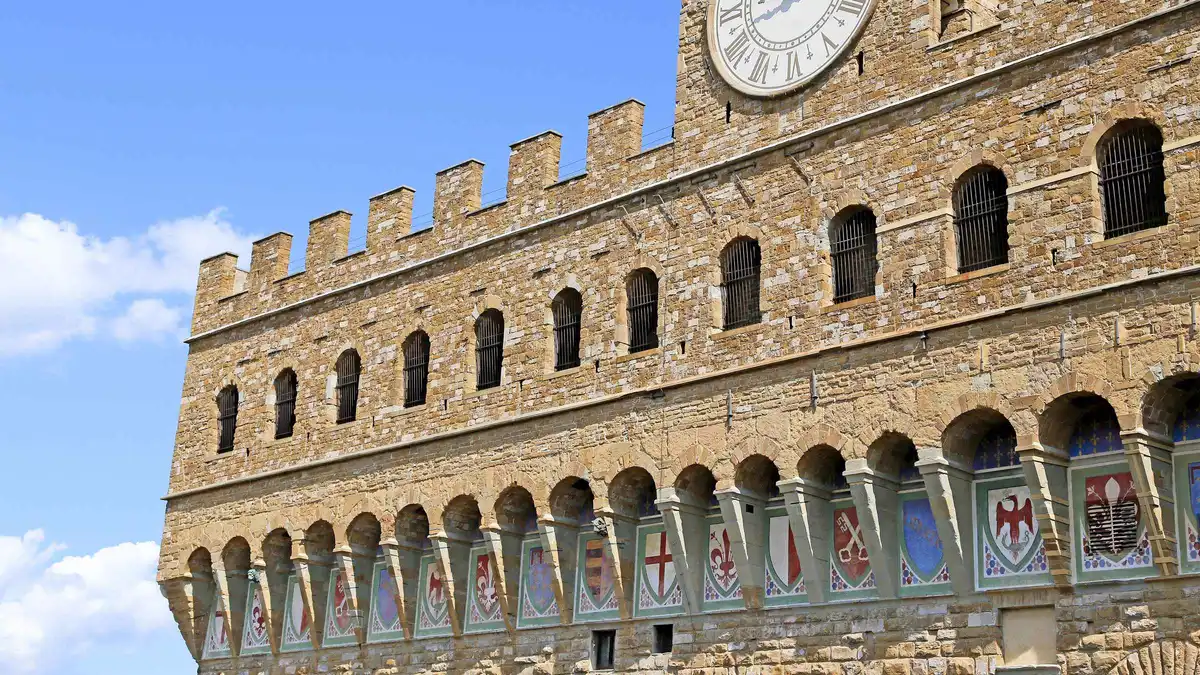 from €32
Florence: Palazzo Vecchio Entrance Ticket & Audioguide
listed at $37.21
Palazzo Vecchio skip-the-ticket-line entry with an audioguide or 7-inch multimedia guide in 8 languages; Arnolfo's Tower as an option.
Check Availability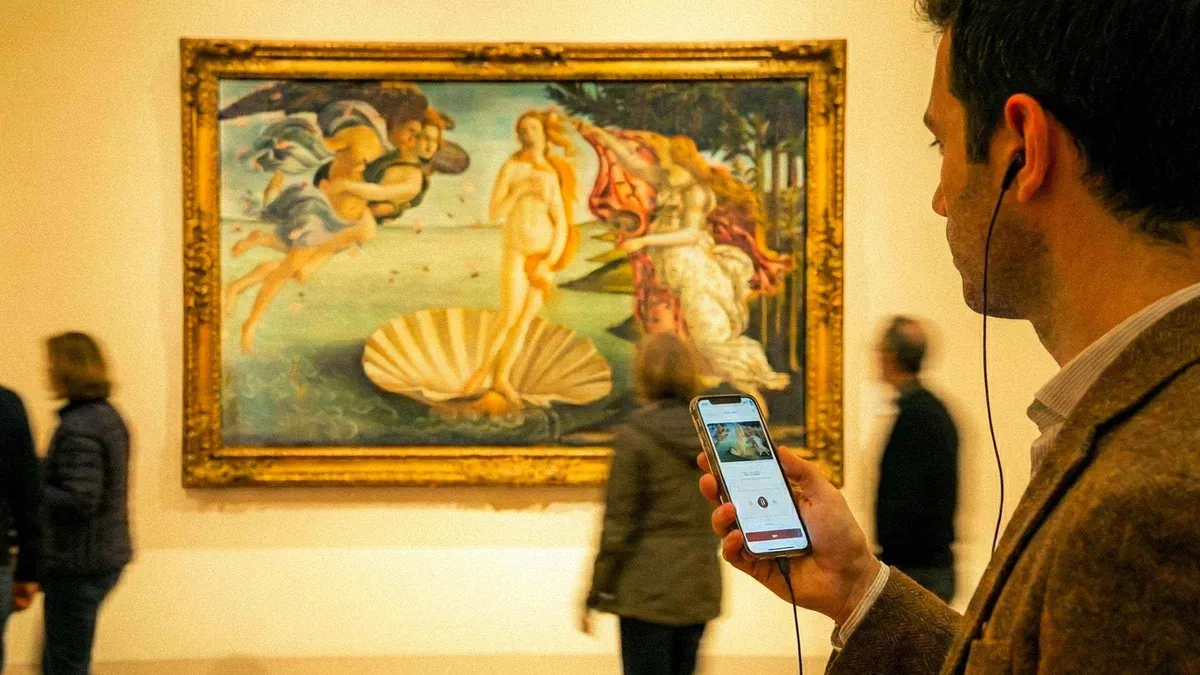 from €16
Florence: Uffizi Gallery Reserved Entry Ticket & Audioguide
listed at $18.53
Reserved timed Uffizi ticket with a downloadable audioguide app in 6 languages and unlimited time inside. Nominative ticket — bring matching ID.
Check Availability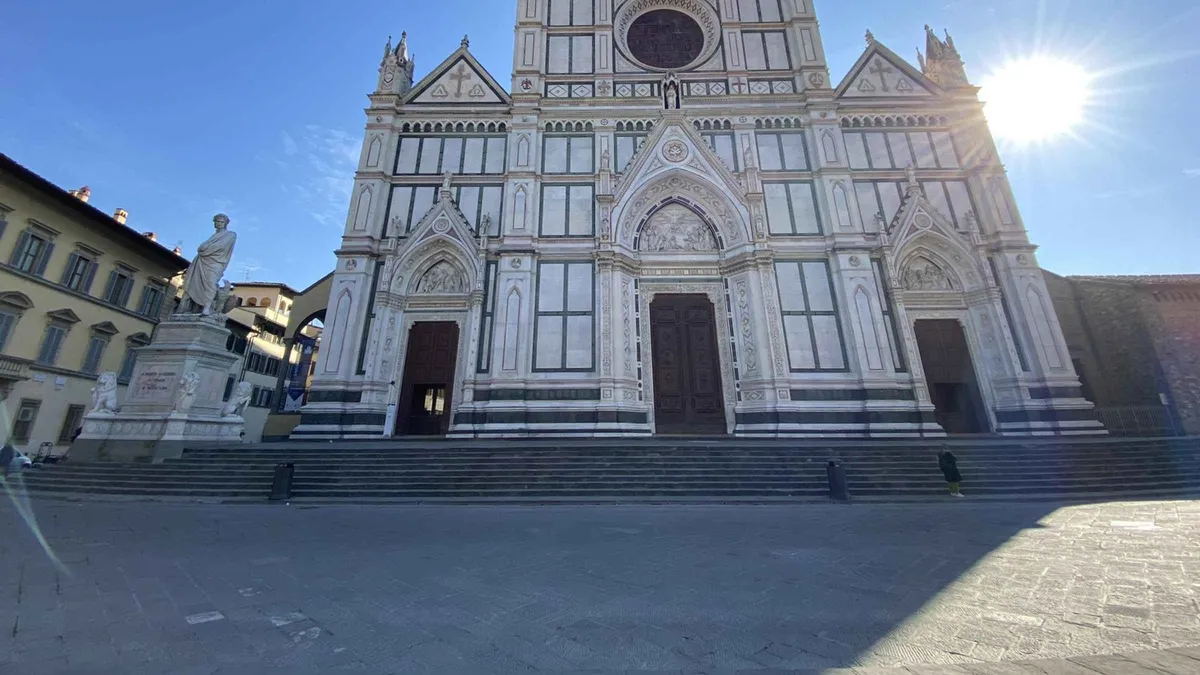 from €36
Florence: 1.5-hour Santa Croce Guided Experience
listed at $41.61
90-minute guided Santa Croce visit with fast-track ticket; Giotto frescoes, Galileo and Michelangelo tombs. English, Spanish or Italian.
Check AvailabilityPrices, ratings and details are the platform's own. Dollar figures are the listed prices. The platform bills in your account's currency.
What it is: the Medici and Lorraine instruments in Palazzo Castellani
This is not a museum built around Galileo and then filled out. It is the surviving scientific property of two ruling houses, which happens to contain the Galileo objects because the Medici collected them from the man himself.
From a room in the Uffizi to a grand-ducal museum, 1775
The instruments began as the Medici collection displayed in the Stanzino delle Matematiche, the mathematics room inside the Uffizi Gallery. Grand Duke Peter Leopold moved them out in 1775 into a purpose-made institution, the Museo di Fisica e Storia Naturale, and the Lorraine dukes who followed kept adding to it through the electrical and chemical experiments of the eighteenth and nineteenth centuries.
That is why the two floors read as two different museums. The first floor is Medici, fifteenth to eighteenth century, and it is about the heavens: globes, armillary spheres, telescopes, the mathematics of navigation. The second is Lorraine, eighteenth to nineteenth, and it is about the laboratory bench.
Palazzo Castellani, an eleventh-century castle on the river
The building is the Castello d'Altafronte, an eleventh-century structure on the Arno bank that later became Palazzo Castellani. In 1929 the First Italian Exhibition of the History of Science made the case that scientific collections were part of Italy's cultural heritage, and in 1930 the University of Florence created the Institute of the History of Science with an attached museum, put it in this building and handed it the Medici and Lorraine instruments.
The institute kept that name — Istituto e Museo di Storia della Scienza — for eighty years. The shorter name on the door today is recent, and it is worth knowing if you are reading an older guidebook that sends you to a museum that seems not to exist.
Why it survives the Uffizi comparison
Our judgement, not a fact: this is the museum to come to on the day after the painting galleries, or on the Monday when they are shut. It is small enough to finish, the objects are singular rather than representative — there is no second copy of Galileo's telescope anywhere — and the labelling assumes you are interested rather than expert. If you have one museum left in you and Renaissance panels are the reason you came to Florence, go to the Uffizi instead; if you have already been, come here.
The Florence museums comparison sets both against everything else with prices and closed days.
What to see: Room VII, and then the two floors
Almost everything anyone comes for is in a single room on the first floor. Room VII is the reason to buy the ticket; the other seventeen rooms are the reason to allow more than an hour.
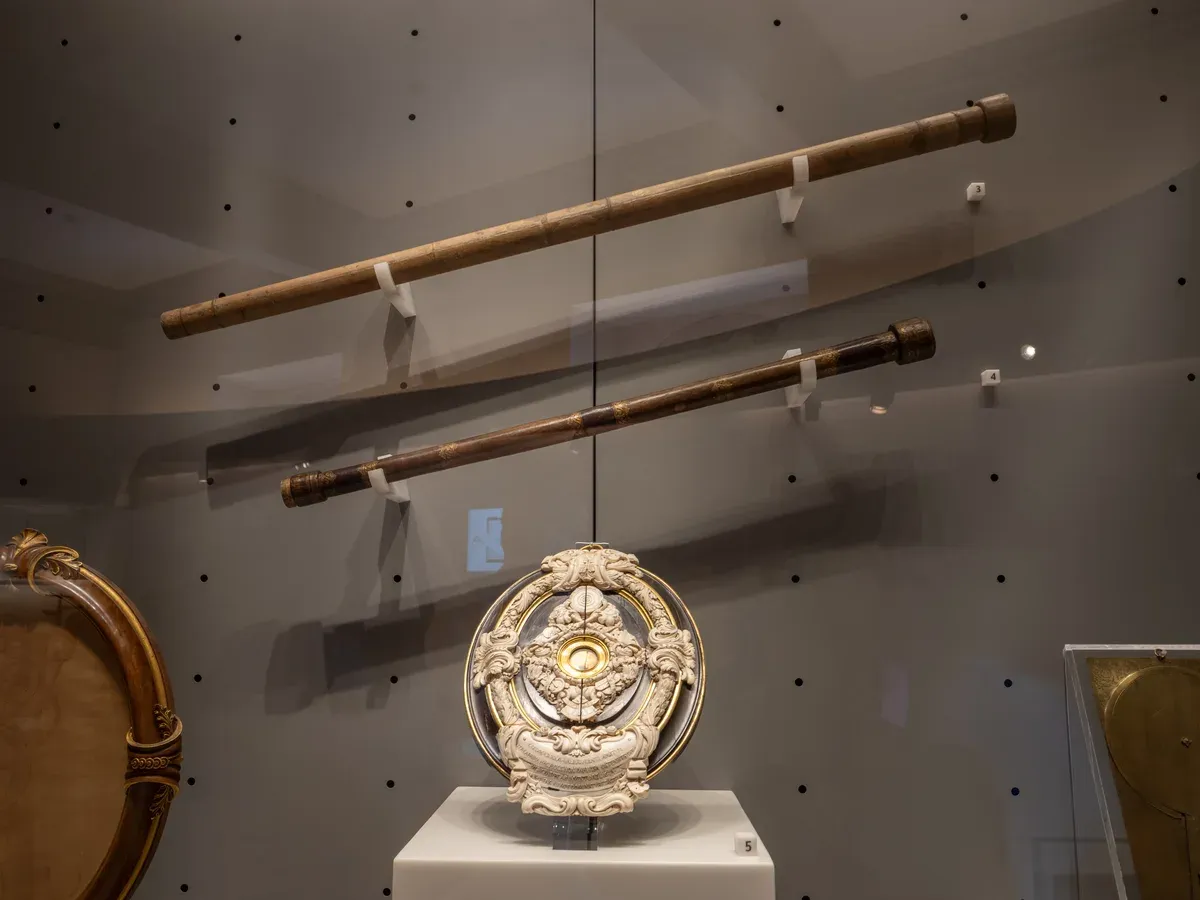
Photo: C messier, CC BY 4.0, via Wikimedia Commons (https://creativecommons.org/licenses/by/4.0)
Room VII: the two telescopes and the objective lens
The museum holds two telescopes made by Galileo and no others exist. One is leather-covered with gold decoration and magnifies about 21 times; the other is built of wooden shells with a paper covering and magnifies about 14. He began using instruments of this kind for celestial observation in the summer of 1609.
Beside them, framed on its own, is the objective lens he used in 1609 and 1610 for the observations that found the moons of Jupiter. Galileo gave it to Grand Duke Cosimo II; after his death in 1642 it stayed in Prince Leopold de' Medici's collection until 1675, entered the Uffizi, moved to the Museo di Fisica e Storia Naturale in 1793 and spent the middle of the nineteenth century in the Tribuna di Galileo. The ebony frame around it was commissioned from Vittorio Crosten by the Medici in 1677, which tells you how quickly this piece of glass stopped being an instrument and became a relic.
Room VII: the finger
The middle finger of Galileo's right hand is in the same room. Anton Francesco Gori detached it from the body on 12 March 1737, when the remains were moved into the monumental tomb they now occupy in Santa Croce. It passed through several institutions and reached the Museo di Storia della Scienza in 1927.
People either find this the strangest object in Florence or walk past it. It is displayed matter-of-factly, in a small glass vessel, without ceremony.
Room VII: the compass, the thermoscope, the jovilabe, the inclined plane
The rest of the room is the working equipment. The geometric and military compass, which Galileo began making in 1597, is a calculating instrument for a wide range of geometrical and arithmetical operations and was the thing he actually sold. The thermoscope of the same year is an egg-sized glass with a long neck that shows air changing density with temperature. The jovilabe is a pair of rotating engraved disks tied to the Jupiter observations and the problem of finding longitude at sea.
The inclined plane, with its five small bells and a pendulum, is the one to stand in front of longest: it demonstrates the law of falling bodies by sound as well as by sight. There is also a compound microscope in the room, which the museum attributes to Giuseppe Campani rather than to Galileo — the label says so, and most guidebooks do not.
First floor, nine rooms: the Medici collection
Around Room VII sit eight more rooms of the Medici collection, fifteenth to eighteenth century. The object that stops people is Santucci's armillary sphere, a giant machine of brass rings built by Antonio Santucci to model the heavens, standing almost the height of its room. There are terrestrial and celestial globes in numbers you do not expect, and the thermometers made by the members of the Accademia del Cimento, the experimental academy the Medici funded from 1657.
Second floor, nine rooms: the Lorraine collection
The upper floor is eighteenth and nineteenth century, and it is the reason to bring anyone who is bored by telescopes. Grand Duke Peter Leopold's chemistry cabinet is here, along with the electrical and electromagnetic apparatus that records what Tuscany contributed to those fields, and the machines built in the workshop of the Museo di Fisica e Storia Naturale specifically to demonstrate physical laws to an audience.
And then the obstetrical wax models from the Santa Maria Nuova hospital, which are anatomical teaching aids of extraordinary and unsettling craftsmanship. Consider that before you bring a child up the stairs; nothing is signposted as unsuitable, and nothing is hidden either.
Hours: the Tuesday half-day and the Monday advantage
The museum opens at 09:30 every day of the week. It closes at 18:00 on Monday and from Wednesday to Sunday, and at 13:00 on Tuesday. Ticket sales stop thirty minutes before closing on any day, so a Tuesday arrival at 12:35 is an arrival at a closed desk. The only annual closures are 1 January and 25 December.
Two Tuesdays in 2026 are exceptions and run to 18:00: 2 June and 8 December, both national holidays.
The Monday opening is the practical reason this page exists. Monday closes the Uffizi, the Accademia, the Bargello, the Pitti Palace and the Medici Chapels — every state museum in the city. It does not close this one, or Palazzo Vecchio, or Santa Croce, or the Duomo monuments. A Monday in Florence that includes this museum is a good Monday; the one-day plan has a Monday version built around exactly that.
- Quietest: the first hour on a Monday or Wednesday, before the Uffizi crowd finds its way east along the river
- Avoid: Tuesday after about 12:00, when sales have stopped or are about to
- Allow: about 1.5 hours for the Galileo rooms and one floor, 2.5 hours with the free app running
Inside: lockers, lifts, the app and the camera rules
Lockers at the entrance are free, and there are two large padlocked storage boxes near the ground-floor ticket office for student backpacks and bulky bags — which matters if you have come from the Accademia, where large bags are refused outright and there is no cloakroom at all.
Accessibility is unusually good for a Florentine building of this age. The step-free ramp is at Lungarno Anna Maria Luisa de' Medici 2 rather than at the Piazza dei Giudici door, two elevators and two wheelchair lifts serve every floor with a limit of 325 kg, a standard manual wheelchair is lent free of charge, and there are accessible lavatories on all floors.
The Museo Galileo App is free and covers about eighty instruments of particular interest. It needs an internet connection, the museum's WiFi is free, and you need your own earbuds for the audio. There is no paid audio-guide rental price stated anywhere on the visitor pages.
- Free lockers at the entrance; two padlocked boxes by the ticket office for big bags
- Step-free entry at Lungarno Anna Maria Luisa de' Medici 2; lifts to 325 kg; free wheelchair loan
- Free app covering about 80 instruments — bring earbuds
- Cameras allowed without flash, tripods or selfie sticks, personal use only; professional shoots need written permission
- Bookshop on the ground floor, with catalogues, history-of-science titles and children's books
Galileo elsewhere in Florence
The man is in two places in this city and they are nine minutes apart. His remains are in Santa Croce, in the monumental tomb built when the body was moved in 1737 — the same move that separated the finger now in Room VII. Entry to the basilica is €10 with a €1 online booking fee, Monday to Saturday 9:30–17:30 and Sunday 14:00–17:30, and the basilica's own estimate for a visit is about 50 minutes. Santa Croce also holds Michelangelo and Machiavelli.
Do them in that order: the museum grants its reduced rate to Santa Croce ticket holders. The reverse does not work, since nothing here reduces the Santa Croce price.
One clarification, because the search results confuse them: the private Leonardo da Vinci museums in Florence are separate institutions with separate tickets, and nothing on this page applies to them. We have not verified their prices or hours and do not print them.
How to get there and which door
The address is Piazza dei Giudici 1, on the Arno embankment immediately east of the Uffizi. From the Uffizi courtyard it is about two minutes; from Piazza della Signoria about three; from the Ponte Vecchio about four along the river; from Santa Croce about nine. Those are our estimates, measured between entrance coordinates and rounded up for the way Florentine streets run.
From Santa Maria Novella station it is roughly an eighteen-minute walk down through the centre. Since 1 August 2026 the urban bus and tram ticket is €2 for 90 minutes, or €3 bought from the driver, and the same ticket covers tram T2 from the airport with no separate airport fare. The getting around page has the routes and the validation rules.
There is no parking and no reason to try. The museum sits inside the ZTL, which is camera-enforced Monday to Friday 07:30–20:00 and Saturday 07:30–16:00, with a night ZTL Thursday to Saturday 23:00–03:00 from April to October.
- Main entrance: Piazza dei Giudici 1
- Step-free entrance and ramp: Lungarno Anna Maria Luisa de' Medici 2
- Ticket desk on the ground floor; sales stop 30 minutes before closing
- Groups of 15 or more must book; individuals never need to
Museo Galileo map: the door and what is next to it
The museum entrance and the four sights within a ten-minute walk along the river and the square.
Next stop from Museo Galileo
Walk minutes are our estimates from the entrance coordinates; the river door puts you closest to the Ponte Vecchio.
Uffizi Gallery
Reserved entry with audioguide €16 (about $19), timed entry, closed Mondays. The Uffizi is the museum this one is the antidote to.
2 min walkPalazzo Vecchio
Entry with audioguide €32 (about $37), open Mondays, closing at 14:00 on Thursdays. Palazzo Vecchio is the other half of a Monday.
3 min walkSanta Croce
€10 plus €1 online (about $13), about 50 minutes. Santa Croce holds Galileo's tomb, and its ticket earns a reduced rate here.
9 min walkMuseo Galileo questions
Is Galileo's finger really in the museum?
Yes. The middle finger of his right hand is displayed in Room VII, detached from the body by Anton Francesco Gori on 12 March 1737 when the remains were moved to the tomb they now occupy in Santa Croce. It reached this museum in 1927. The Room VII section covers what stands beside it.
How long does it take to go through Museo Galileo?
The museum does not state a visit length. Our routing is about an hour and a half for Room VII and one of the two floors, and about two and a half hours if you run the free app, which covers around eighty instruments. That makes it the museum that fits into an afternoon with something else — the one-day plan pairs it with Palazzo Vecchio on a Monday.
Is Museo Galileo open on a Monday?
Yes, Monday 09:30–18:00, which is the day the Uffizi, the Accademia, the Bargello, the Pitti and the Medici Chapels all close. Tuesday is the day to watch instead: the doors shut at 13:00 and ticket sales stop half an hour before that. The exceptions are 2 June and 8 December 2026, two Tuesdays that run to 18:00.
Do I need to book tickets for Museo Galileo?
No. There is no timed slot and no reservation system for individuals. Only groups of fifteen or more are required to book. If you want the entry sorted before the day, the entry ticket at €17 (about $20) puts the voucher on your phone with free cancellation up to 24 hours before.
Is there a discount for Museo Galileo?
Several. Ages 6 to 18 pay a reduced rate and under-6s are free. There is a family ticket for two adults with up to two under-18s, or one adult with three. A Santa Croce ticket, or a Unicoop, Feltrinelli or ACI card, also earns the reduced rate, so visit Santa Croce first. The €85 Firenze Card includes this museum with no reservation required.
Is Museo Galileo worth visiting?
Our judgement: yes, if you have already done a painting gallery, and yes without qualification if instruments and mechanisms interest you at all — there is no second copy anywhere of Galileo's telescopes or of the lens that found Jupiter's moons. It is not the museum to spend your only Florence morning on. The museums comparison sets it against the alternatives with prices and closed days.
Is this the Leonardo da Vinci museum in Florence?
No. The Leonardo museums in Florence are separate private institutions with their own tickets and hours, which we have not verified and do not print. This is the state and university collection of Medici and Lorraine scientific instruments in Palazzo Castellani, and the Leonardo material here is in the library and temporary exhibitions rather than the permanent route.
Can I take photographs inside?
Yes, for personal use, without flash, tripods or selfie sticks. Professional shoots need written permission from the museum. The lighting in Room VII is low and the cases are glass, so expect reflections on the telescopes — the what to see section says where to stand for each object.
Museo Galileo on video
Three walk-throughs, including the museum's own, useful for seeing the scale of Santucci's sphere and the size of the telescopes before you decide how long to allow.
Galileo Museum in Florence, Italy
A room-by-room walk through both floors, including the Room VII cases described above.
Video: A Quantum Scientist's WorldThe First Science Museum
The museum's own film about the Medici and Lorraine collections and how they came to Palazzo Castellani.
Video: Museo GalileoChasing Galileo's Finger in Florence
A visitor's route to the relic in Room VII, filmed alongside other lesser-known Florence stops.
Video: Trevor CarlsonVideos are other people's work, chosen because they show the rooms. Prices and hours quoted in them are not ours and are not checked; the figures on this page come from the museum's own pages.
Where this museum fits in a Florence day
Two natural shapes. The first is the Monday: Palazzo Vecchio in the morning, this museum after lunch, Santa Croce before it closes at 17:30 — three good rooms on the day everything else is shut, which the Monday version of the one-day plan sets out with times. The second is the Santa Croce pairing on any day: the basilica first for the tomb and the reduced rate here, then nine minutes west along the river to Room VII for the finger and the lens, which is a strange and satisfying way to spend an afternoon.
At any other hour it is the two-minute detour from the Uffizi that most visitors never make. If you are building a longer trip, the two-day plan and the three-day plan both leave room for it, and every museum in the city compared shows what else opens when this one is on its Tuesday half-day.
Every other museum, church and viewpoint in the city has its own page here, and the routes between them are set out in the day plans linked above. The lens and the dials make more sense with someone explaining them, which is why several Florence guided tours include a stop at this museum on their way along the river.
Prices, hours and terms are set by the venue or operator and confirmed at checkout.
We may earn a commission if you book through one of our links, at no extra cost to you. Full affiliate disclosure